
Words by Sara Snow ~ Photos by Dave Snow
Seafood Stories
Hana Nelson and Philip Docker, innovators in our local food supply chain, inspire us to go further.

Hana Nelson with a handful of growing oysters
Big Island, N.S., is connected to the mainland by a long sandy causeway—a beach that stretches for two kilometres to an island tucked in along the Pictou County shores of the Northumberland Strait. In the early hours of September 24th, Hurricane Fiona made landfall with reported wind gusts of 179 km/h at nearby Arisaig. The Canadian Hurricane Centre reported the central pressure dropped to its lowest measurement on record for a landfalling storm. Massive waves washed out the road—knocking the breakwater, and the beach, onto the road—and in some areas ripped the pavement up into chunks, making the road impassable.

Amy Hill and Nelson survey the recovery process on shore
Two weeks later, on a morning where the wind is little more than a breath and the sea is gently rolling up along the sand, the causeway road is clear and the rocks that serve as the breakwater are piled high once again. Along Big Island, as through much of Pictou County, the clearing of fallen trees, piles of newly cut wood, debris and twisted siding, remain as evidence of Hurricane Fiona. The sound of chainsaws is now commonplace throughout the region.
Just before we turn down the road to the farm where Hana Nelson and her husband, Philip Docker, live with their children, we pass a crew clearing the remains of an old barn. Nelson knows the one. She tells us of her neighbours who are mourning its loss, like the loss of an old friend. Big Island residents are no strangers to big storms, or washouts, but this one was especially fierce. Nelson describes the wind coming out of the north as something long-time locals, people who had weathered many storms, had never experienced.
“We had a line of pines and they’re all gone,” Nelson says as she points toward the edge of their property. Thousands of trees were knocked down throughout the region. Fortunately, Docker and Nelson had put ties on their solar panels for Hurricane Dorian in 2019. They are completely off-grid and maintained power through the storm. Their oyster farm infrastructure, on the other hand, did not fair as well. The powerful winds and waves swept oyster nursery cages down the bay and tossed oyster equipment and an entire building into the bay. Over the past two weeks, their team has recovered a lot but some will be irrecoverable.
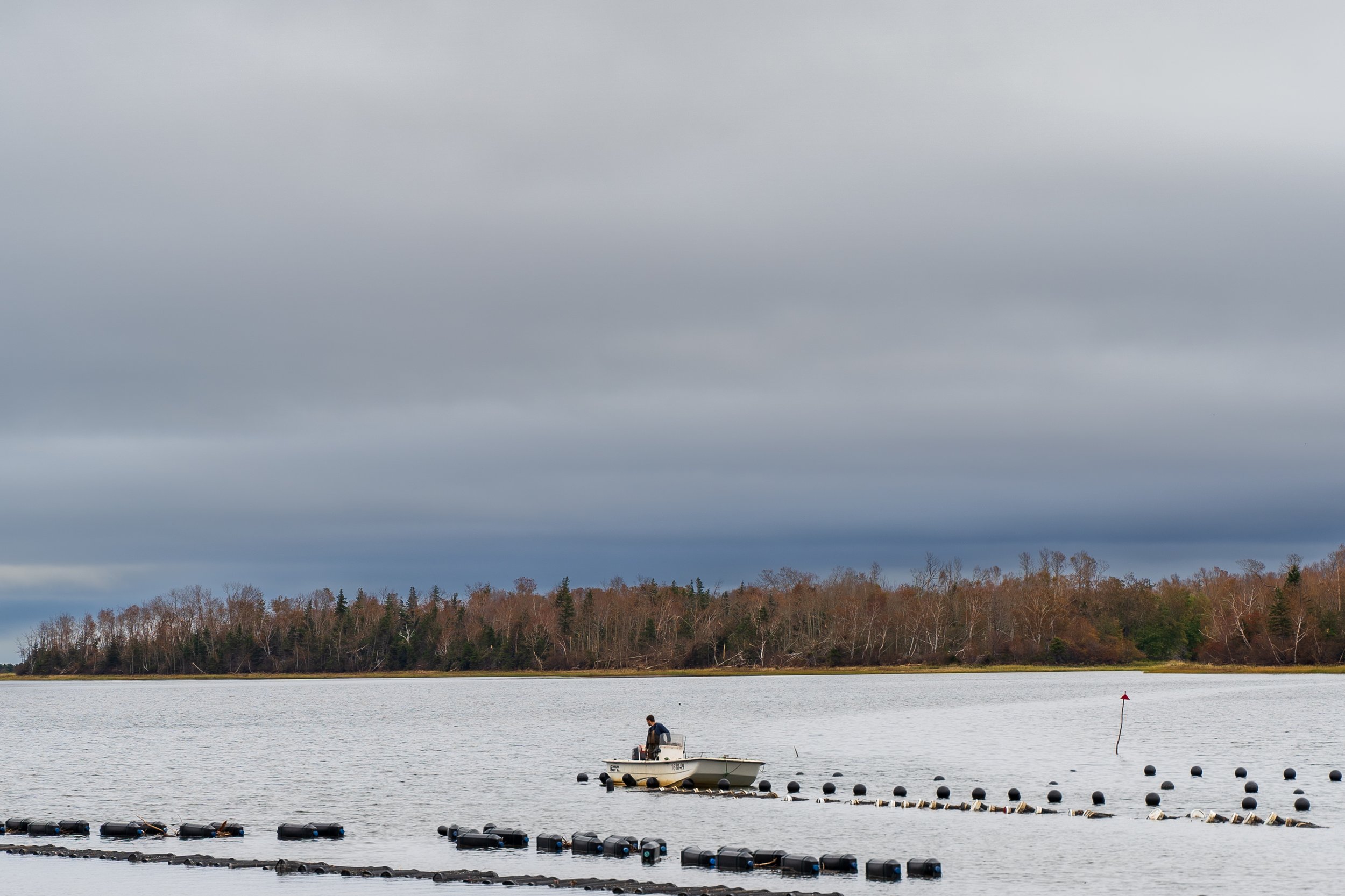
Above: Alex Bouchie tending to a line of BOBRs, with a row of conventional grow-out units and a row of BOBRs in the foreground
ShanDaph Oysters is Nova Scotia’s only solar-powered oyster farm. Docker’s grandparents helped to reestablish the growing and harvesting of oysters along these shores, setting native oyster seed through the ‘60s and ‘70s. These matured into productive oyster beds and in 1999 Docker established ShanDaph Oysters, a name derived from his grandparents’ names—Shan from the WWII pilot flight name of his grandfather Everett and Daph for his grandmother Daphne.
With a degree in marine biology, Docker returned to Big Island and has been farming oysters here for nearly twenty-five years. He picks up a couple of oysters from a load that will be going back out to the water and traces the lines on the oyster shell with his fingers. “These lines are weather damage,” he explains, “a storm maybe. Like a tree,” he adds, “I can track how much growth by the markings. This is year one for this one,” he says as he picks up another, “born in June or July, the next year it put that much growth on.” Docker is clearly at one with the ecology of this place. “Philip,” Nelson explains, “is really good at knowing the water and what species are setting. He places indicator shells in the water, checking them every day.”
The conditions oysters grow in is key for Docker. “It’s their merroir,” he says, “like terroir.” Merroir, a term Seattle Times food writer Greg Atkinson coined in 2003, like terroir, refers to the local conditions where seafood is raised. For an oyster, merroir can include tides, local food sources, growing techniques, salinity, climate and the seasons. Here, on the Merigomish Harbour side of Big Island, Nelson says, “rivers feed fresh water into the bay providing for a high level of nutrients, well-suited to oyster growing. The shallows get a higher water temperation,” she adds, pointing to the bay, “so we have great conditions for growing.”
“Mother Nature controls food and feed,” Docker adds, “all we can control is access.”
The work of growing and harvesting is ongoing in the oyster business. This morning, in addition to post-storm clean up and recovery, the ShanDaph crew is tending to the oysters. Alex Bouchie, who has worked for Docker for several years, is pulling into shore to pick up a load of oysters for the growing units that float in the bay like buoys.
Conventional oyster growing in the Maritimes typically involves off-bottom culture, floating bag systems called grow-out units. Rows of floating units—long, rectangular buoys—is a familiar site along the coasts of this region. While capital costs are higher up front, than bottom growing, the grow-out suspension system helps avoid predators and pests, provides lower risk of siltation, and better access to nutrition and tidal flow in the water column.
After working with these grow-out units for years, Docker became concerned with the challenges of oyster farming—from the heavy lifting that limits who can do the work, to the defouling process (removing barnacles and other organisms that restrict water flow and access to nutrition), sorting, tumbling and sinking cages. He began experimenting with different sizes, shapes, and materials, working on a system that would improve efficiency, quality and worker experience. Local professional engineer and oyster growing enthusiast, Ernie Porter, took an interest in Docker’s work and the two partnered to create a new mechanized system that involves a smaller, cylindrical cage, called the BOBR. The timing was perfect. Bouchie had just returned to the region with a degree in aeronautical engineering from Carleton University and the skills needed to get Docker and Porter’s designs to a manufacturer. Docker and Porter formed Dockport Ltd. and launched BOBRs commercially along with a custom work platform, which their team affectionately refers to as “the boat”.
Like grow-out units, the BOBR units are used on static lines or as intertidal tumblers. Because they are smaller they are easier to handle. Their cylindrical shape makes rotating them from the side of the boat to defoul in fresh air and sunshine easier. The BOBR work platform mechanizes the process, drawing the BOBR cages from the water on a conveyor belt simplifying defouling, tumbling, harvesting and resinking. Their shape gives the BOBRs a lower profile on the water providing for a clearer view and less availability for bird landings.


Above left: Bouchie sorts oysters to put back out in the water
Above right: Docker pulls out a BOBR for defouling
Both the BOBR and the new work platform are game changers in the oyster farming industry. A 2016 Sustainable Agriculture Research and Education (a producer-driven, decentralized competitive grants and education program in the U.S.) study that compared cylindrical-shaped cages with other experimental shapes, found that a cylindrical design dramatically reduces manual cleaning. Evidence of this is not only in the increased efficiencies, it is the experiences of the ShanDaph team itself. Bouchie and co-worker Amy Hill agree BOBRs are easier to work with. Amy Hill, who started working with ShanDaph in 2021 says “it’s easier to grab the BOBR.” Hill is a graduate of Dalhousie University’s Agricultural College in Truro, N.S.. She explains that most of the students in the agriculture and aquaculture programs at the school are women. These fields are transforming, partly because of the women, like Hill, who are digging into them.
“I majored in animal science and aquaculture,” Hill explains, “and my professor told me about the work Docker was doing and suggested I contact him.” Docker partners with the school and providing internship opportunities to students. “Last summer, two of our three interns were women,” Nelson says. “The BOBRs make a huge difference, making it possible for more women to take up this work.”
Hill started working with Docker on DockPort’s BOBR cage project in 2021 to help other oyster farmers transition to this new technology. “Farmers don’t change technology overnight,” she explains, “but these are designed to make it easier.” The BOBRs are designed to fit the bags that are used in conventional grow-outs providing for a smooth transition.



Top left: Dave Lewis preps a box of seafood for delivery
Top right: Ben Zavitz, heads up Afishianado's processing and delivery
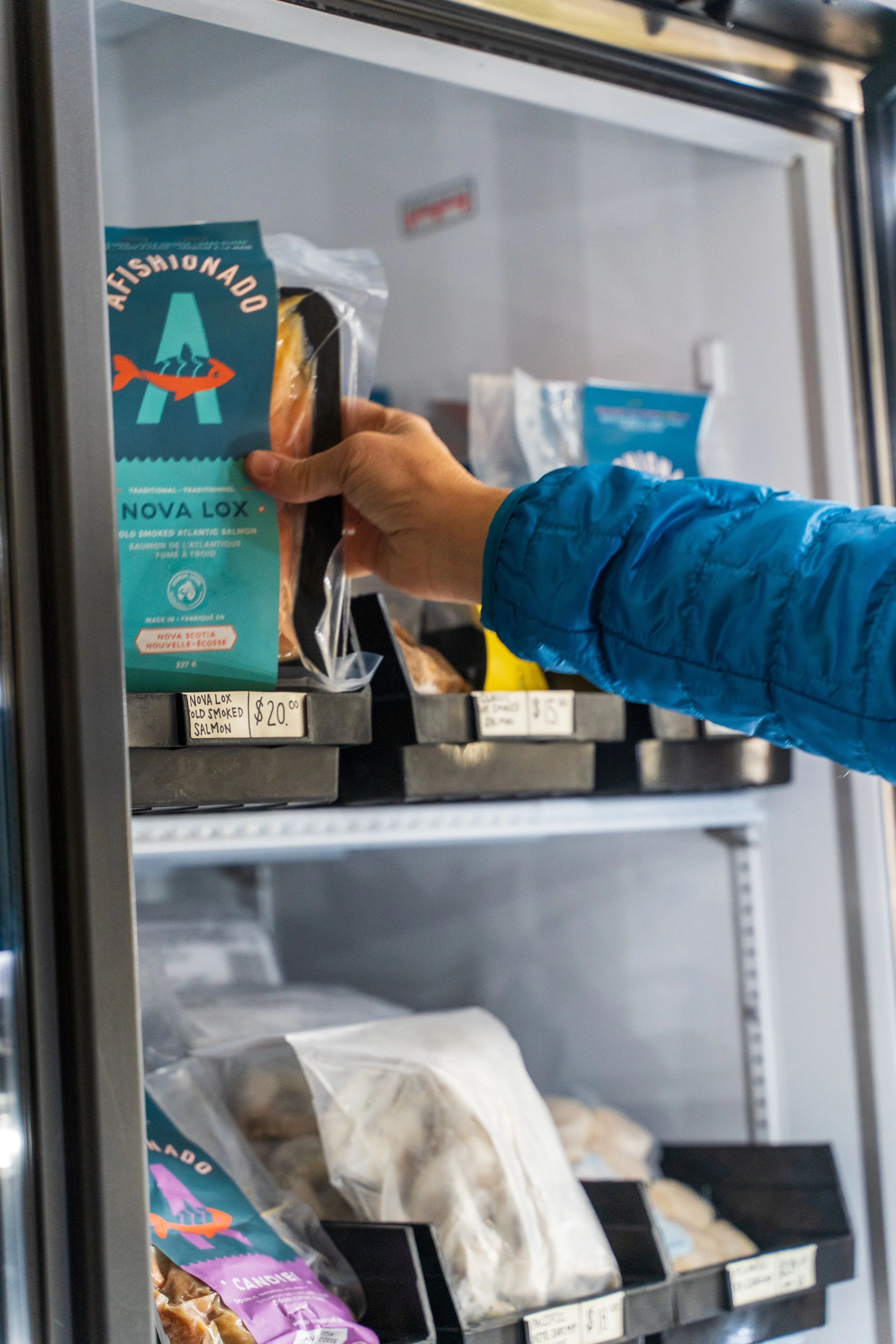
Bottom left: Afishianodo smoked salmon for sale at the Warehouse Market in Halifax
Bottom right: Peter McChesney packing Nova Lox, their cold smoked salmon
Nelson and Docker share a passion for sustainable food systems and processes. They met at Halifax farmers’ markets where Docker was selling his oysters and Nelson local seafood. Nelson grew up on her family’s farm outside of Ottawa and when her parents moved to Switzerland for work, Nelson followed them to Europe and did a masters in agro-ecology in Norway and France. “My interest was food systems,” she explains, “and this program provided a multidisciplinary approach. I did my thesis on food insecurity and rising food prices and how that affects the poor in Sri Lanka, examining how people were responding to economic challenges.”
Nelson brought her economic lens to the food supply chain in Nova Scotia and took a position as a Food Transition Officer with the Government of Nova Scotia. It was a one year contract and just long enough for Nelson to “learn there is a bounty of agricultural producers here to do business development with, or to call for a local event,” she explains. “But when it came to seafood,” she adds, “there was nobody to call. There were very few seafood stories in our local food system.”
She was curious about the appetite for local, traceable and sustainable seafood and opened a small fresh fish counter at Halifax’s Local Source Market in 2014. It turned out there was a big appetite. “I had two employees at that time and I thought let’s take all of this interest and make it easier to access,” she remembers. When faced with the decision to open her own retail space, she landed on a delivery model, inspired partly by a refrigerated truck she found online. She bought a one-way ticket to Montreal to pick it up and came back with the truck and a new way of getting local seafood to the people. She launched Afishianado Fishmongers with a fish subscription program where customers could sign up for a Big Fish Box or a Little Fish Box and a wide selection of local, sustainable fish and seafood; along with the stories behind them. “In the first week I had a hundred people,” she says.
As Nelson engaged with sustainable and traceable seafood suppliers she developed a relationship with Sustainable Blue, a salmon fishery in Burlington, N.S., that raises salmon without antibiotics or growth hormones in a unique land-based ecosystem. “They are doing something different and they want people to share their story with their wider audience,” she says. “To process their salmon I started a processing plant in 2016 and I realized that if you want any traceable, sustainable seafood,” she explains, “you have to buy the whole catch, piecemeal doesn’t work for seafood, it's perishable.”
The demand for sustainably-raised salmon continued to grow and she partnered with Chad Poirier, artisan fish smoker, to set up Afishianado’s salmon smoking facility in Bedford. When we visited Afishianado Fishmongers' newly renovated space in Bedford, product development manager Peter McChesney and processing specialist Dave Lewis, were setting up the brand new slicer. McChesney, a geologist and self-described large-systems enthusiast, grinned as he took us back to the large, gleaming slicing machine. The size of it suggests they slice a lot of salmon in a week. “We do about 140 pounds a load, five days a week and until now,” McChesney said. “This machine will be 60 to 80 times faster,” he adds. With a background in fishmongering for large retail chains and five years of processing at large fish and seafood company, Lewis started here in 2021 and explained he’s enjoying being part of a smaller company. “I’m seen as a person here,” he said, “and I really like working for a smaller, local company.”
At the front of the shop, Sam Bartol, Afishianado’s director of consumer fulfillment, was stocking shelves with local and sustainably-caught or -raised seafood. When he first started with Afishianado he was making deliveries and said “I liked the interactions I had with everyone - people are excited about what we do.”
Afishianado’s operations director Laurie Starr joined the company early on. In a post on Afishianado’s blog at her five year anniversary, she wrote that “Afishianado has provided me with an outlet for my contribution to the sustainable seafood movement.” “The fate of the human world,” she added, “depends on the ocean’s persistence to thrive with life and abundance.”

Nelson discusses sustainable seafood on the shore
It is impossible to talk about seafood sustainability without aquaculture. “When you look at the 2.6 billion that we brought in for seafood in Nova Scotia last year,” Nelson says, “and then look at the world where 60% of seafood is from farmed sources. If we’re not farming now, this won't last, that 2.6 billion will be gone.”
The development of oyster aquaculture in Nova Scotia has lagged behind other provinces. “Farming like this is huge in New Brunswick and Prince Edward Island but hardly anybody does it in Nova Scotia,” Nelson explains. The Government of New Brunswick estimates oyster leases cover 2,700 hectares and P.E.I. estimates 2,953 hectares of oyster leases. Nova Scotia’s oyster production is a fraction of New Brunswick and Prince Edward Island’s, something Nelson suggests shouldn’t be the case, considering the “length of our oyster-growing appropriate coast line here.”
So what’s the hold up in Nova Scotia? There are several possible answers. One might be a resistance to aquaculture in the province. In 2016, the Nova Scotia government placed a moratorium on any new aquaculture leases while they did a regulatory review. The moratorium was lifted a year later but new leases have been slow to come. “In Nova Scotia, we tend to be more open to farming the land, than farming the sea,” Nelson says, “maybe because we are more likely to be connected to a farmer.” Or perhaps it's partly the optics of it. While we are familiar with, and value, views of grazing sheep or rows of corn or kale, floating rows of oyster cages may be startling to those who are unfamiliar. For those of us who have grown up along coasts where aquaculture is a familiar site, the floating symmetry of oyster cages is often a beautiful reminder of the work that goes into growing our food.
Just as agricultural farmers are engaging innovative, sustainable and ecologically sound farming techniques, some aquaculture farmers are as well. And, in the case of oyster aquaculture, science backs it. In their 2007 “Habitat Management Qualitiative Risk Assessment: Water Column Oyster Aquaculture in New Brunswick” for the Oceans and Science Branch of Fisheries and Oceans, Bastien-Daigle, Hardy and Robichaud concluded that water column oyster aquaculture is of low risk to the productive capacity or the ecological integrity of fish habitat. In fact, they suggest that “oysters in aquaculture can potentially be of significant benefit to these estuaries and can help to restore many important ecological functions which were reduced following the historical decline of natural populations.”
While the provincial moratorium on aquaculture leases was lifted, Bouchie, who has worked for Docker for years, applied for his own license in 2019 and is still waiting for a response. “Alex is the kind of person,” Nelson explains, “that we should be giving licenses to. He’s young, he grew up here, he’s smart and he wants to do this. Plus, he works for us so we can help. It would be awesome,” she adds, “but how do we get young people to do this if the licensing process is so slow.” For Bouchie, an application process that claims to take three-months has been a years-long wait.
Another factor that contributes to the slow uptake of aquaculture in the province might be, as Nelson points out, the lack of “accessory industries”. “While oyster farming is an industry with all of the necessary accessory industries in N.B. and P.E.I.,” she explains, “such as seed selling, distribution, welders, none of that is available here. You do it all yourself.” As more people take up sustainable farming, this must change.
Docker and Nelson and their teams at ShanDaph and Afishianado are creating a space for people to engage with sustainable techniques and local growing. Whether it’s through signing up for a Big Fish Box or employing DockPort’s BOBR technology to increase efficiencies, their teams are providing important opportunities for approaches that our planet needs now.
As it swept through the region, Hurricane Fiona highlighted the urgency of community-based sustainability. While people in Port aux Basques, N.L., are forced to find new homes, and the Cape Breton community of New Haven pick up the pieces after their fish plant was nearly destroyed, it is clear we are in the midst of a climate crisis. Their commitment to innovation and sustainable systems place Docker and Nelson at the forefront of much needed change making. As the Conference of the Parties, or COP, convenes in Egypt, one of the key issues they are discussing is our collective ability to adapt to climate change and build resilience. Docker and Nelson and their incredible teams are teaching us just that. Through their stories we might learn how to live on and with our changing planet in a more sustainable way. 🦪
